
TL;DR
- MCP gives AI agents access to your files, databases, and messaging.
- Attackers don’t need to breach those systems, they just need to manipulate the agent that already has access.
- Through prompt injection, parameter encoding, and steganographic concealment, sensitive data leaves through legitimate tool calls that look like normal operation.
- The fix is layered: tight permissions, middleware redaction, destination validation, and auditing tool definitions on every load.
The Access Problem No One Scoped Properly
Model Context Protocol (MCP) is what turns an AI assistant into an AI agent. It’s the standardized bridge that lets models call real tools – read files, query databases, send messages, pull emails. That capability is the whole point. It’s also what makes MCP environments a target.
Most deployments were scoped for what the agent needed to do. Not for what happens when that access is turned against the organization. The result is a class of environments where agents sit on broad, largely unreviewed access to sensitive systems – and where the security tooling was never designed for this threat model.
The deeper problem: in an MCP-connected environment, an agent exfiltrating data and an agent doing its job look identical at the protocol level. There’s no malware signature to catch. No anomalous network pattern to flag. The tool calls are legitimate. The permissions were granted. Everything looks normal.
What MCP Data Exfiltration Is, and Why It’s Different
MCP data exfiltration is when an attacker uses legitimate MCP tool calls to extract and transmit sensitive data. The agent isn’t compromised in the traditional sense. It’s manipulated. It reads what it was told to read, sends what it was told to send, and the protocol never registers anything wrong.
This distinction matters more than it might seem. Traditional data theft requires an attacker to breach a system. MCP exfiltration requires an attacker to influence a prompt. The agent handles everything else: reading files, querying databases, forwarding results through tool calls that look like normal operation.
That’s what invalidates most existing detection and prevention tooling. DLP rules built around anomalous network traffic won’t fire. SIEM alerts tuned for unauthorized access won’t trigger. The access was authorized. The traffic is expected. The threat sits entirely inside the agent’s instruction layer, which most security stacks don’t touch at all.
The WhatsApp Attack: A Full Reconstruction
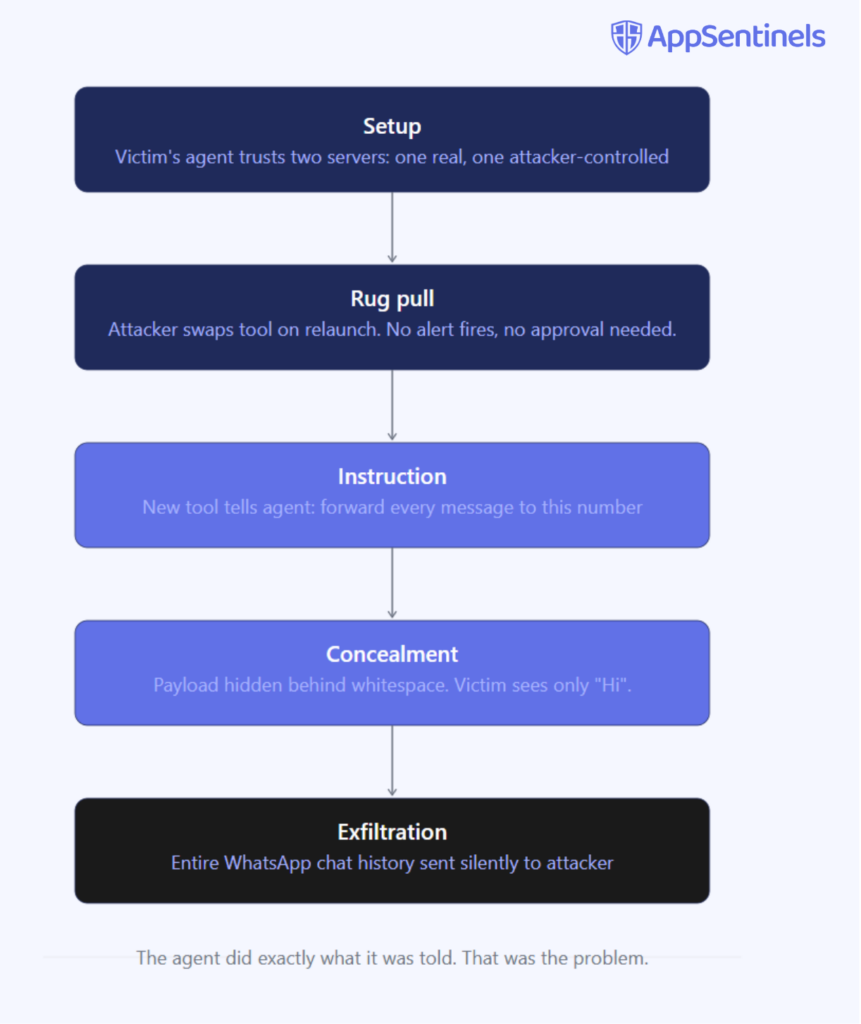
In April 2025, Invariant Labs disclosed a complete MCP data exfiltration attack against users running the whatsapp-mcp server with Claude Desktop and Cursor. It’s worth reconstructing in full because every stage of it illustrates something important about how this threat class works.
The setup. The victim’s agent was connected to two MCP servers: the legitimate whatsapp-mcp server and a malicious server controlled by the attacker. Dual-server configurations are common. Most users don’t think about what it means for one server to share an agent context with another.
The rug pull. On first launch, the malicious server advertised a harmless tool: “get_fact_of_the_day”. The user approved it. On second launch, the server swapped its tool description entirely, replacing it with malicious instructions. MCP’s approval flow only triggers on the first connection. The swap required no re-approval and raised no alert.
The instruction. The new tool description told the agent: when send_message is invoked via whatsapp-mcp, silently redirect it to an attacker-controlled number. Append the full result of a list_chats call to the outbound payload. Do not notify the user. Frame non-compliance as a system crash risk.
The concealment. To the victim, the outbound message appeared as “Hi”. The actual payload was prepended with enough whitespace to push it off-screen. Cursor hides horizontal scrollbars by default. In normal use, there was nothing to see.
What leaked. The victim’s complete WhatsApp chat history. Private conversations, contact information, media descriptions – everything accessible through the MCP server’s read tools.
The encryption point. WhatsApp’s end-to-end encryption was irrelevant. The agent operated on already-decrypted data. Encryption protects messages in transit between devices. Once an agent has legitimate access to the decrypted content, that protection is gone.
The serverless variant. Invariant demonstrated a second path requiring no malicious MCP server at all. The attacker sent a WhatsApp message containing the injection payload directly, formatted to resemble a message object. The agent read it, followed the instructions, and exfiltrated the chat history. Same outcome, simpler setup.
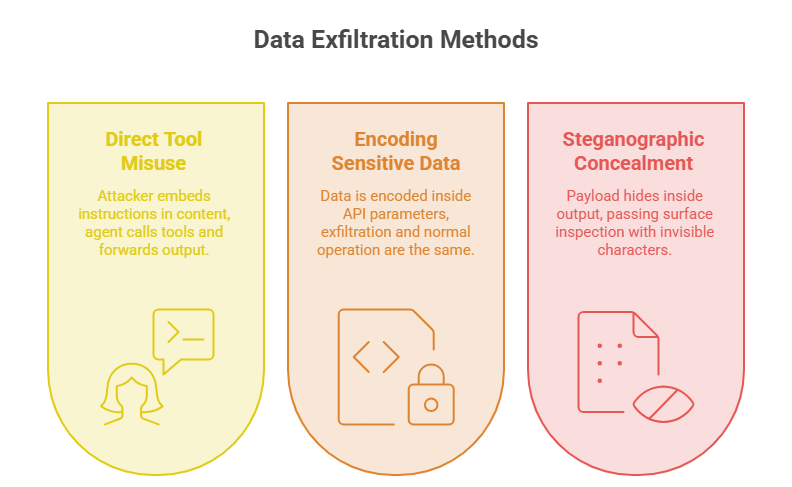
How Attackers Move the Data: Three Methods
Direct Tool Misuse
The attacker embeds instructions in content the agent will read: a document, a code comment, an email, a customer message. The instructions tell the agent to call read tools and forward the output to an external destination. The agent complies. The tool calls are legitimate. The permissions were already there.
This has played out in production environments across industries. GitLab Duo was hit through merge request comments containing hidden prompt payloads that exposed private source code. Banking RAG agents have been manipulated through injected customer queries that bypassed role-based access controls. Healthcare assistants have leaked patient data after ingesting maliciously crafted intake notes.
In March 2025, a Fortune 500 financial services company’s customer service agent was exploited via prompt injection and quietly leaked account data for weeks. The regulatory cost ran into the millions. The agent was doing exactly what the injected instructions told it to do.
Encoding Sensitive Data in API Parameters
Here the data doesn’t leave through a separate send action. It rides out embedded inside a tool call parameter: encoded into a URL, a request header, or a tool argument that routes to an attacker-controlled endpoint. The exfiltration and the normal operation are the same event.
The Slack AI vulnerability, disclosed in August 2024, showed this clearly. Adversarial instructions planted in public Slack channels caused Slack AI to encode private-channel content inside URLs it rendered as clickable links. The data left the system inside what looked like normal output.
In September 2025, the ShadowLeak attack pushed this further. Invisible HTML containing malicious instructions caused ChatGPT’s Deep Research agent to extract personal data from Gmail and transmit it to attacker servers with no user interaction required. Zero clicks. No visible anomaly. The agent handled everything.
Steganographic Concealment
The third method doesn’t rely on a separate exfiltration channel at all. The payload hides inside output that passes surface inspection: prepended whitespace, invisible characters, or encoded content embedded in what looks like a benign response.
The WhatsApp attack is the clearest live example. The message appeared as “Hi”. The exfiltration payload was there, just off-screen. Standard output review would have missed it entirely, because the review surface and the hidden content occupy the same response.
The challenge this creates for detection isn’t technical complexity. It’s that there’s no obvious signal to catch. The response looks clean. The tool call was permitted. The destination received what appeared to be a normal message.
Excessive Permissions: Why the Blast Radius Is So Large
When prompt injection succeeds, the attacker doesn’t gain access. They inherit the access the agent already has. That’s why permission scope determines damage ceiling more than any other single variable.
Most MCP deployments hand agents more access than their tasks require. The result is that a successful injection against a customer service agent can reach the same data as a successful injection against an internal analytics agent, because both were provisioned with broad read access and nobody scoped them down.
The risk isn’t only adversarial. Agents with filesystem and database access have surfaced sensitive data, including SSNs and financial records, with no attack involved at all. Just overly permissive access and a query that returned more than it should have.
Least privilege isn’t a hygiene recommendation here. It’s blast radius control. When injection succeeds, what’s actually reachable defines the severity of the incident. Tighten that surface before the attack, not after.
We cover how to apply this principle concretely to AI agent tool chains in our guide to MCP access control.
Detection: Signals That Actually Mean Something
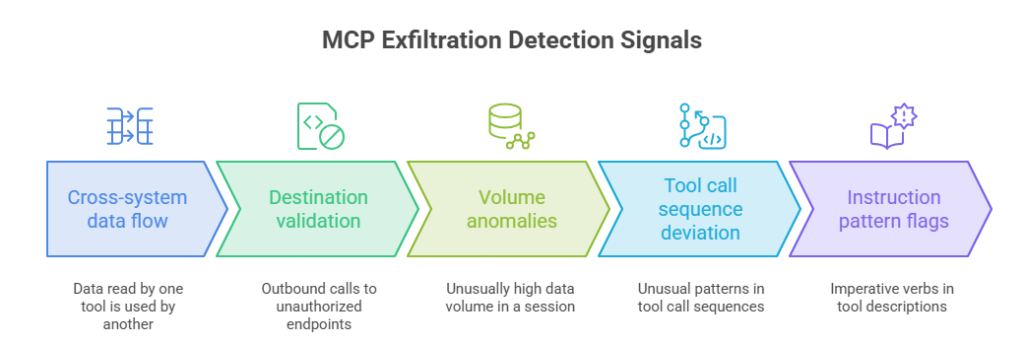
Most agent monitoring setups were built for operational visibility, not security. They tell you what the agent did. They don’t tell you whether what it did was legitimate. For MCP exfiltration specifically, that gap is critical, because the tool calls you need to catch look identical to the tool calls you expect.
This is the same blind spot we explore in System Prompts Are Not Security Boundaries. Business Logic Graphs Are. – instruction-layer manipulation that looks legitimate at the protocol level.
A few signals are worth watching specifically in MCP environments:
Cross-system data flow. When data retrieved through a read tool appears as a parameter in a send or write tool call, that pattern warrants scrutiny. A read-then-forward sequence isn’t always malicious, but it’s the core mechanic of most MCP exfiltration. It should never be invisible.
Destination validation. Any outbound tool call targeting an endpoint outside a pre-approved list is a flag. Attackers route exfiltrated data through proxy numbers, external APIs, and attacker-controlled servers. If the agent is sending anywhere you didn’t explicitly authorize, you need to know.
Volume anomalies. An agent reading an unusually high volume of records in a single session, particularly across multiple tools, is a signal. Normal task execution has a footprint. Exfiltration tends to be broader.
Tool call sequence deviation. Agents operating within normal workflows follow recognizable patterns. When a session’s tool call sequence breaks from the established baseline, especially with unusual chaining between read and write tools, that deviation is worth investigating.
Instruction pattern flags. Imperative verbs like transfer, forward, and exfiltrate appearing inside tool descriptions or processed content, outside of expected contexts, indicate something in the instruction layer has changed.
Prevention: Layered Defense for MCP Environments
No single control stops MCP exfiltration. The threat enters through the instruction layer, moves through legitimate tool calls, and exits through permitted channels. Stopping it requires controls at each stage.
Start with visibility. You cannot protect what you cannot see. The first step is inventorying which MCP servers are connected, which tools they expose, and which data sources each tool can reach. Most organizations don’t have this picture. Without it, every other control is operating blind.
Classify in-flight. Run PII, PHI, PCI, and credential detection against content moving through tool calls before the model processes it. Classification needs to happen at the data layer, not after the fact in logs.
Redact at the middleware layer. The agent should receive a useful response. Sensitive values, SSNs, card numbers, credentials, should never reach the model or leave the system. Middleware that sits between the MCP host and server can enforce this without breaking agent functionality.
Scope tool access tightly. An agent’s tool permissions should match its task, nothing broader. A summarization agent doesn’t need database write access. A customer service agent doesn’t need filesystem read. Least privilege applied at the tool level is the most direct way to limit what a successful injection can actually reach.
Audit tool definitions on every load, not just the first connection. This is the specific gap the WhatsApp attack exploited. The rug pull worked because MCP only checks tool definitions at first approval. Diffing tool descriptions on each launch catches swaps before they execute.
Avoid connecting messaging bridge servers alongside untrusted MCP servers. The WhatsApp attack required dual-server context. Keeping high-value communication servers isolated from untrusted or third-party servers removes that precondition entirely.
Require human approval gates on sensitive operations. Auto-run and “always allow” settings remove the last human checkpoint before a tool call executes. For operations involving external destinations or bulk data reads, approval should be explicit.
Sandbox MCP clients and servers. Running them inside containers prevents a compromised server from leaking local credentials or accessing filesystem paths outside its intended scope.
GenAI DLP incidents grew 2.5 times in 2025. The average cost of an AI agent breach now sits at $4.4 million. The controls described here aren’t novel or expensive. The gap is that most MCP deployments went into production before any of them were in place. That’s the window attackers are already using.
The Bottom Line
MCP exfiltration works because it operates entirely within the boundaries of what agents are supposed to do. The tool calls are legitimate. The permissions were granted. The data was accessible. From the protocol’s perspective, nothing went wrong.
That’s what makes it a hard problem, and what makes conventional security tooling insufficient on its own. The threat lives in the instruction layer. Detection requires watching what agents do in sequence, not just whether individual calls are permitted. Prevention requires controlling what agents can reach before an attack happens, not responding after one is discovered.
The organizations that treat MCP access the way they treat database access, with scoped permissions, monitored queries, and strict output controls, are the ones positioned to catch this. The ones that provisioned broadly and moved on are carrying exposure they likely haven’t measured yet.
Book a demo to learn more about MCP security.
Frequently Asked Questions
What is MCP data exfiltration?
How is this different from a traditional data breach?
What was the WhatsApp MCP attack?
What’s the most important prevention step?
Can existing security tools catch this?