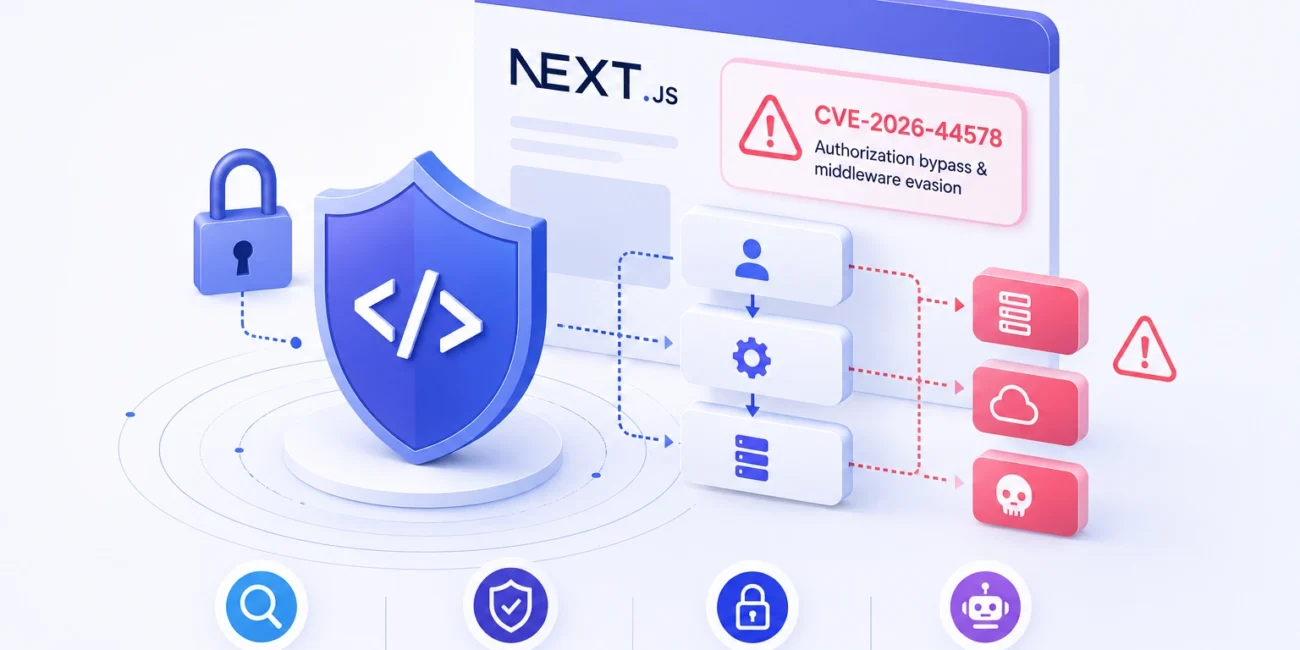

A newly disclosed security issue, tracked as CVE-2026-44578, affecting Next.js applications is raising concerns across the developer and security communities after researchers identified multiple authorization bypass and middleware evasion paths that could expose protected application data and credentials. The vulnerabilities impact several versions of Next.js and allow attackers to bypass middleware-based authorization controls using crafted requests and route manipulation techniques. Affected deployments include applications relying heavily on middleware for access enforcement. Organizations are advised to upgrade immediately to patched versions.
The issue becomes particularly dangerous because modern Next.js applications increasingly power customer portals, SaaS platforms, AI applications, and API-driven ecosystems. If authorization checks fail, attackers may gain access to user account information, session tokens and API credentials, internal APIs and backend services, Cloud secrets and environment variables, and sensitive business workflows.
While this might be viewed as a framework vulnerability problem, this is increasingly a business logic and runtime API security challenge.
Security incidents involving Next.js have already demonstrated how exposed credentials can escalate into broader compromise scenarios, including API token theft, cloud credential exposure, and unauthorized access campaigns targeting public-facing applications.
What is CVE-2026-44578 and Who is Affected?
CVE-2026-44578 is a high-severity Server-Side Request Forgery (SSRF) vulnerability affecting self-hosted Next.js deployments using the built-in Node.js server. The issue resides in the WebSocket upgrade handler, where crafted requests can cause vulnerable Next.js instances to proxy requests to internal services and cloud metadata endpoints. The vulnerability has a CVSS score of 8.6 and requires no authentication or user interaction for exploitation.
The vulnerability affects Next.js versions 13.4.13 and later, all 15.x releases before version 15.5.16, and all 16.x releases before version 16.2.5, while the issue has been addressed in patched versions 15.5.16 and 16.2.5. Vercel-hosted deployments are not affected because the vulnerability impacts only self-hosted applications using the built-in Node.js runtime path.
Why This Vulnerability Matters Beyond Framework Patching
Although CVE-2026-44578 originates at the framework layer, the impact extends into runtime API exposure, credential compromise, and business workflow abuse.
Attackers may leverage exploitation paths to target internal APIs and backend services, administrative interfaces, Cloud metadata endpoints, environment variables and secrets, API tokens and credentials, and sensitive business workflows. The larger concern is what happens after the initial bypass succeeds.
This becomes particularly relevant because API attacks increasingly target application behavior rather than infrastructure weaknesses. Organizations should assess not only patch status but also runtime exposure and authorization risks.
Why Traditional Security Controls Miss This
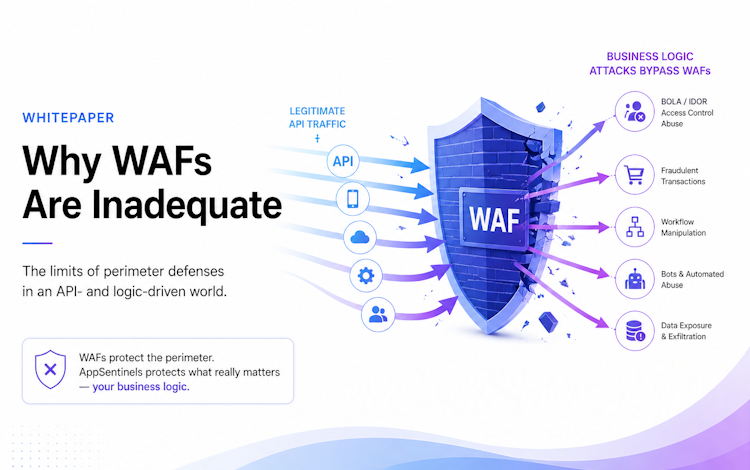
Most organizations rely on traditional controls such as Web Application Firewalls (WAFs), authentication layers, rate limiting, and SAST/DAST scans to protect applications. These controls remain important, but attacks exploiting SSRF and application workflows can still evade detection because the requests often appear valid.
In the case of SSRF, attackers do not necessarily use malformed payloads or exploit obvious vulnerabilities. Instead, they manipulate application behavior and backend request flows.
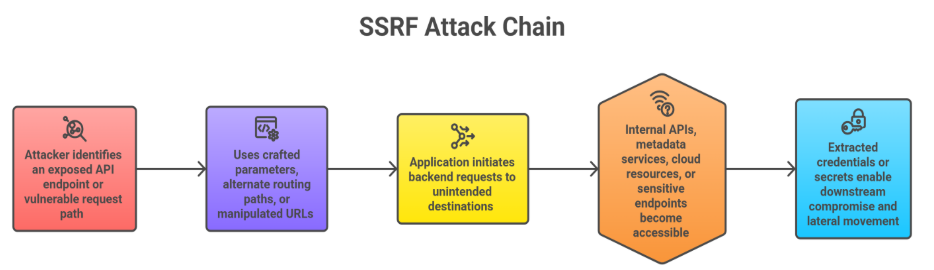
From a traditional security perspective, the attack chain shown above may still appear legitimate because the request format is valid, authentication may succeed, payloads may not trigger signatures, and the traffic resembles normal application behavior.
Traditional WAFs primarily inspect inbound requests and known attack signatures. However, SSRF attacks often depend on where the application sends requests after processing user input, which is harder to detect using signature-based inspection alone.
This is where runtime API and business logic security becomes important. Platforms such as AppSentinels understand API behavior, request execution paths, and URL usage patterns across applications. Rather than only inspecting payloads, runtime monitoring can identify:
1. Unexpected outbound destinations invoked by APIs
2. Abnormal URL patterns or unauthorized endpoint access attempts
3. Requests targeting internal services or metadata endpoints
4. API workflows deviating from expected behavior
5. Credential exposure and downstream business workflow abuse
As applications increasingly expose APIs to AI agents, MCP servers, and automated workflows, understanding runtime behavior becomes essential because attackers increasingly target application execution paths rather than application code alone.
How AppSentinels Helps Protect Against These Attacks
AppSentinels addresses these risks through runtime API and business logic security rather than relying only on signature-based detection.
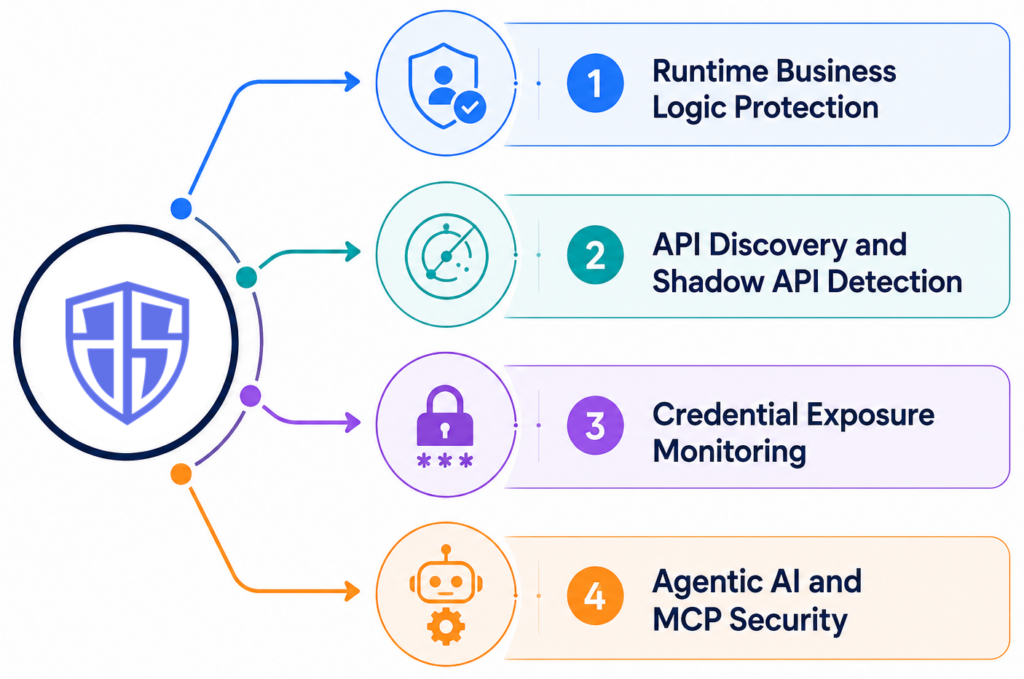
Runtime Business Logic Protection
AppSentinels monitors API execution paths and user behavior to identify Broken Object Level Authorization (BOLA), unauthorized object access attempts, business workflow abuse, excessive privilege access, and session misuse patterns. Even if middleware is bypassed, runtime controls can still detect anomalous access patterns.
API Discovery and Shadow API Detection
Next.js applications often expose undocumented APIs. AppSentinels continuously discovers public APIs, shadow endpoints, AI agent APIs, MCP-connected services, and internal service dependencies. This reduces blind spots created by framework complexity.
Credential Exposure Monitoring
Credential theft is rarely the end goal. AppSentinels helps identify secret exposure risks, sensitive API responses, data exfiltration paths, token abuse patterns, and excessive response payload exposure.
Agentic AI and MCP Security
As AI agents increasingly consume APIs built on frameworks like Next.js, vulnerabilities become amplified. AppSentinels extends protection into MCP servers, Agent-to-tool interactions, AI runtime flows, and business logic abuse in agentic workflows. This is critical because AI agents can unintentionally execute vulnerable API paths at machine speed.
In simpler terms, AppSentinels helps organizations move beyond prevention by continuously monitoring API behavior, detecting business logic abuse, identifying unauthorized access attempts, uncovering shadow APIs, and securing AI-driven interactions before they escalate into material risk.
Move Beyond Patching, Protect Runtime Risks
Framework vulnerabilities will continue to emerge. The bigger risk is what happens after the bypass succeeds, and that is where runtime API and business logic protection become essential. While framework patches address the vulnerability, runtime security addresses the impact.
Book a demo to see how AppSentinels help secure APIs, business workflows, MCP servers, and agentic AI systems against runtime attacks and business logic abuse before they become breaches.
Frequently Asked Questions (FAQs)
1. What is the Next.js credential exposure vulnerability and why is it important?
The recent Next.js vulnerability highlights how authorization bypasses and middleware evasion techniques can expose protected routes, credentials, APIs, and sensitive application data. This issue is particularly important because many modern SaaS applications, customer portals, AI platforms, and API-driven environments rely on Next.js for both frontend experiences and backend functionality. If attackers successfully bypass authorization controls, they may gain access to sensitive APIs, session tokens, internal services, and critical business workflows. Beyond patching the framework itself, organizations must also evaluate the runtime impact of exposed APIs and potential business logic abuse scenarios.
2. How can API security platforms help prevent Next.js exploitation?
API security platforms help organizations go beyond vulnerability remediation by providing visibility and runtime protection across API ecosystems. While patching addresses the underlying framework issue, API security solutions can identify unauthorized API access attempts, detect Broken Object Level Authorization (BOLA) attacks, uncover shadow and undocumented APIs, monitor sensitive data exposure, and identify credential misuse patterns. Runtime API security platforms such as AppSentinels continuously analyze API behavior to detect malicious activity even when requests appear legitimate from a syntax and authentication perspective.
3. What are business logic attacks and how do they relate to Next.js vulnerabilities?
Business logic attacks occur when attackers exploit intended application workflows instead of software flaws or malformed requests. In a Next.js environment, an attacker may leverage a middleware bypass to reach an API endpoint using completely valid requests. Rather than exploiting code execution vulnerabilities, the attacker abuses application behavior to retrieve unauthorized records, access sensitive objects, manipulate transactions, or exfiltrate data. Examples include accessing another user’s order information, exploiting excessive data exposure, or escalating privileges through valid application paths. These attacks are difficult to detect because the requests often appear normal and can evade traditional security controls.
4. Why is runtime API security important for AI agents and MCP servers?
As organizations adopt agentic AI systems and MCP (Model Context Protocol) servers, APIs increasingly become the backbone for agent-to-tool interactions and automated workflows. If APIs contain authorization gaps or exposed business logic paths, AI agents may unintentionally trigger vulnerable workflows at scale. Runtime API security becomes essential because it continuously monitors AI-to-tool interactions, detects unauthorized API activity, secures MCP communications, and identifies anomalous agent behavior. As AI ecosystems continue to expand, API security and AI runtime protection are becoming closely interconnected requirements.
5. How does AppSentinels protect against business logic abuse and API attacks?
AppSentinels provides runtime API security designed to identify attacks that traditional controls often miss. The platform continuously monitors application behavior to detect business logic abuse, authorization attacks, sensitive data exposure risks, shadow APIs, and abnormal API usage patterns. AppSentinels also extends protection into MCP environments and agentic AI systems, helping organizations secure AI-driven workflows and runtime interactions. By focusing on behavior rather than signatures alone, AppSentinels helps organizations reduce the impact of API attacks, credential exposure incidents, and workflow abuse before they escalate into larger breaches.